


 Collection · 6 products
First aid kitsCAN/CSA Z1220-24
Workplace first aid kits and refills compliant with CSA Z1220:24, built for Canadian workplaces: offices, shops, job sites and industrial facilities. The supplies inside have a 4-year shelf life.
Which one is yours?
Pick your workplace and we'll show you the right one.
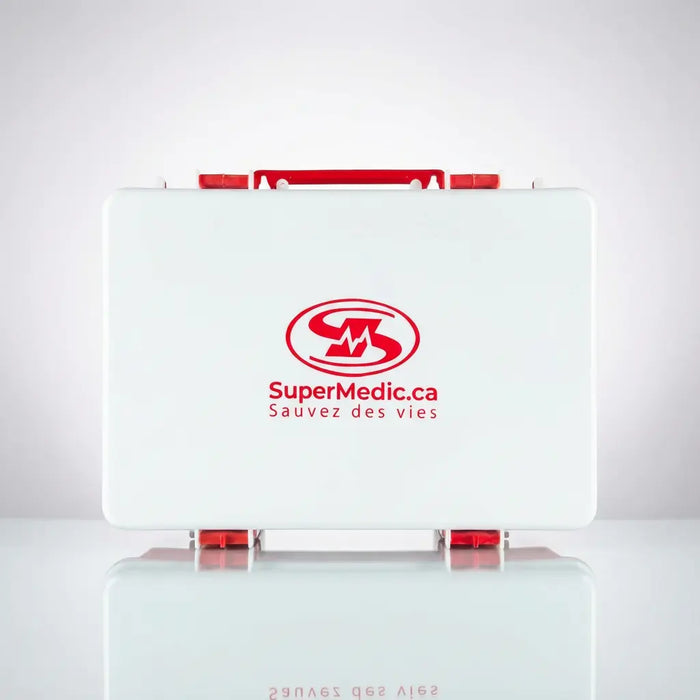
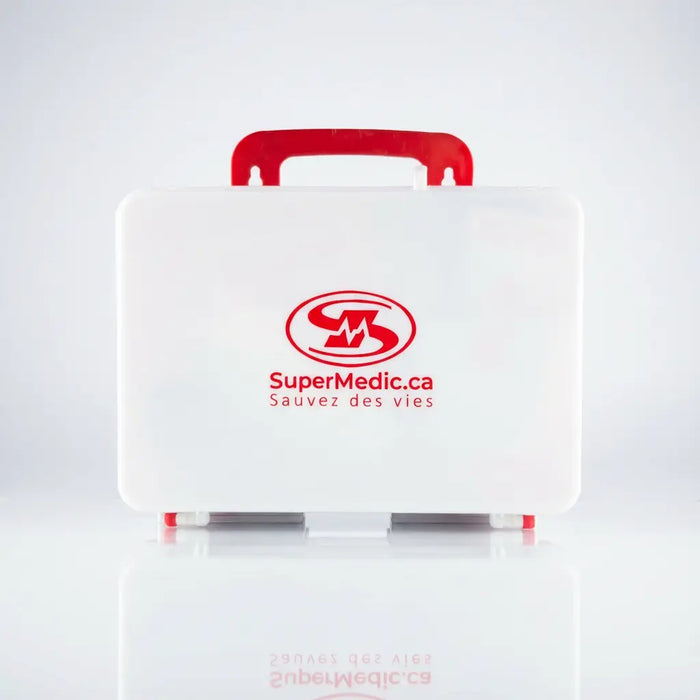
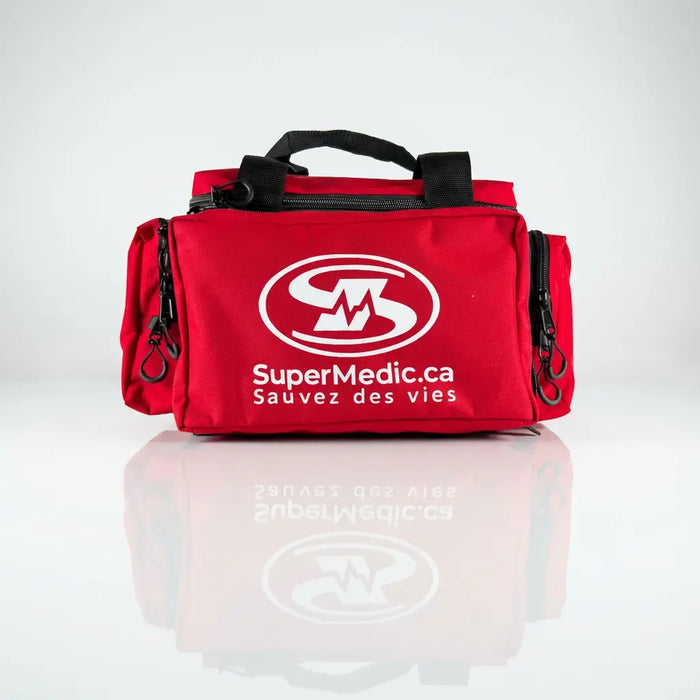
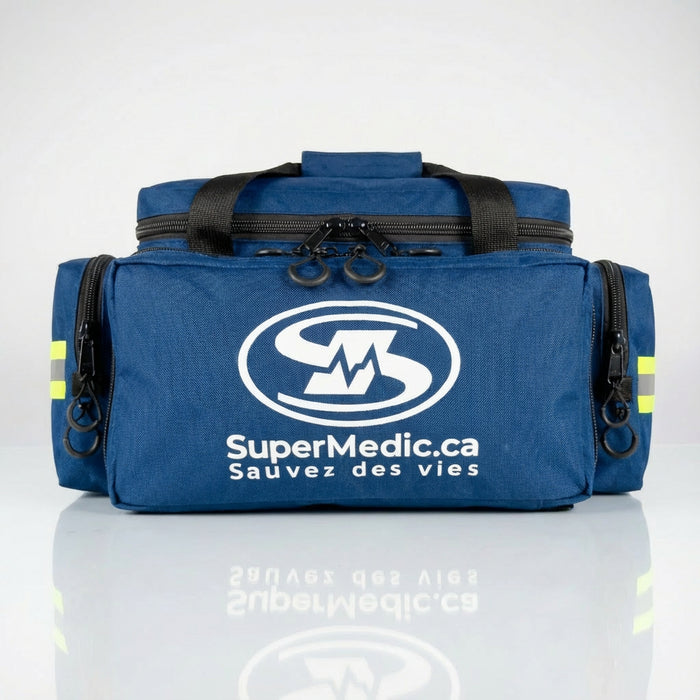

Every kit has its refill.
Every 4 years, the refill makes everything new again. You keep the case: lower cost, less waste.
See the refillsThe guide.
What to know before you choose.
CSA Z1220 Compliant First Aid Kit: For Canadian businesses
In Canada, every employer must provide first aid supplies for their workers. The CAN/CSA Z1220-24 standard is the national reference for the contents of workplace first aid kits, and several provinces refer to it in their regulations.
Each province has its own rules: in Quebec, it is the regulation on minimum first aid standards (CQLR c A-3.001, r. 10), enforced by the CNESST. Federally regulated businesses follow the Canada Labour Code (SOR/86-304).
Everywhere, the principle is the same: a complete, accessible and up-to-date kit.
To learn more: our complete guide to CSA Z1220-24 kits, the FAQ on the real cost of a kit and our workplace regulations page.
Which kit should you choose? Two criteria make all the difference
Your kit choice depends on two variables defined by standard CAN/CSA Z1220-24: the risk level of your workplace and the number of workers per shift. These criteria apply across Canada.
| Risk level | Workers per shift | CSA type | SuperMedic kit |
|---|---|---|---|
| Low | 2 to 25 | Type 2 — Basic, small | Basic first aid kit |
| Low | 26 to 50 | Type 2 — Basic, medium | Basic first aid kit |
| Low | 51 to 100 | Type 2 — Basic, large | Basic first aid kit |
| Moderate or high | 2 to 25 | Type 3 — Intermediate, small | Intermediate first aid kit |
| Moderate or high | 26 to 50 | Type 3 — Intermediate, medium | Intermediate first aid kit |
| Vehicle / lone worker | — | Type 1 — Personal | Vehicle first aid kit |
| Daycare / childcare centre | — | Quebec Ministère de la Famille | Daycare first aid kit |
| Designated first aider / paramedical | — | Advanced use | Nylon paramedic kit |
| Several responders / large sites | — | Advanced use, several users | Multi-user paramedic kit |
Not sure about the risk level of your industry? Provincial occupational health and safety organizations publish industry profiles to guide you.
What the law requires of you as an employer
Whether you are in Alberta, Ontario, Quebec, or British Columbia, your obligations are the same: first aid equipment must be kept in working order at all times. Three concrete responsibilities:
- Regularly check the contents and after each use
- Immediately replace used, expired, or damaged equipment
- Keep a maintenance log to document checks in case of inspection
In the event of a workplace accident with an incomplete first aid kit, the employer may be held responsible for any injury aggravated by the absence of compliant equipment.
Consult our workplace regulations page for details by province.
Our CAN/CSA Z1220-24 compliant kits
Basic first aid kit — low risk
For offices, businesses, and administrative environments across Canada. Complies with CAN/CSA Z1220-24 standard, available in nylon, plastic, or metal casing.
→See the basic first aid kit
Intermediate First Aid Kit — Moderate or High Risk
For industrial, construction, or high-risk environments. Reinforced content compliant with Type 3 of CSA Z1220-24.
→See the CSA-compliant intermediate kit
First aid kit for childcare facility
Compliant with the requirements applicable to daycares, childcare centres (CPE) and childcare services in Quebec and equivalent standards in other Canadian provinces.
→See the daycare first aid kit
First aid kit for vehicle and lone worker
Compact format for workers on the road, in transit or in isolation, applicable in all provinces and for federally regulated workers.
→ See the vehicle first aid kit
Replenish your kit: never leave it empty
An used and unrefilled kit is a useless kit. Our CSA compliant refill packs are referenced by kit type to ensure compliance with CAN/CSA Z1220-24, across Canada.
The kit is the equipment. Training is effectiveness.
In most Canadian provinces, OHS regulations require the presence of a designated first aider trained in the workplace. Our first aid training courses are accessible across Canada, in French and English, for individuals and corporate teams.
Complete your equipment
- Our defibrillators for businesses: for cardiac arrests, every second counts
- Our intervention tools: for designated first responders
- Our first aid equipment: to complete by unit
- Our kits for individuals: home, travel, hiking
Need a quote for your business?
Are you equipping several workstations or multiple sites across Canada? We deliver nationwide, in French and English.
Contact us for a quote, our team will respond quickly.
Common questions.
What is the CAN/CSA Z1220-24 standard?
CAN/CSA Z1220-24 is the Canadian standard that defines the contents of workplace first aid kits. Updated in 2024, it replaces Z1220-17. It is the reference across Canada, and several provinces refer to it in their regulations.
It classifies kits into three types according to two criteria: the level of risk in the workplace and the number of workers per shift.
SuperMedic kits are assembled in accordance with this standard.
Is a compliant first aid kit mandatory in my company?
Yes. Every employer must provide first aid supplies for their workers. The required contents depend on your province (in Quebec, the regulation on minimum first aid standards) or, for federally regulated businesses, on the Canada Labour Code (SOR/86-304).
The CAN/CSA Z1220-24 standard is the reference for putting together a kit suited to your risk level and number of workers per shift.
The employer is responsible for the contents, accessibility and upkeep of the supplies.
How do I know if my workplace is low, moderate, or high risk?
The level of risk is determined by the nature of the activities carried out in your establishment. An office, a shop or a professional practice generally corresponds to a low risk (type 2 kit — basic).
A construction site, a manufacturing workshop, a warehouse or any environment involving machinery, chemicals or work at height is considered moderate or high risk (type 3 kit — intermediate).
Provincial health and safety organizations publish detailed risk profiles by sector of activity to help you determine your level.
If in doubt, contact our team, we can guide you to the right kit.
What is the difference between the basic kit and the intermediate kit?
The basic first aid kit (type 2) is designed for low-risk environments.
It contains essential supplies for treating common injuries: cuts, minor burns, bruises. The intermediate kit (type 3) is intended for moderate- and high-risk environments.
Its contents are more comprehensive: it includes large wound dressings, hemorrhage control equipment, lightweight splints, and more supplies to manage more serious injuries while awaiting emergency services.
The number of items is also higher, proportional to the risk level and the number of workers per shift.
What is a federal first aid kit (SOR/86-304)?
The federal kit is intended for businesses subject to the Canada Labour Code, i.e., those operating in federally regulated sectors: interprovincial transportation, banks, telecommunications, broadcasting, and postal services.
These businesses are not subject to provincial regulations but to federal regulation SOR/86-304, which defines specific content distinct from the provincial CSA standard.
If you are unsure of your jurisdiction, please consult our Workplace Regulations page or contact us directly.